Gu Huaian Is Hospitalized with Gastritis from Overeating
I’m Very Happy After Marrying the CEO Husband According to the AgreementGu Huaian Is Hospitalized with Gastritis from Overeating marks a revealing reversal in Shen Tang and Gu Huaian’s relationship: Shen Tang, unable to eat much herself while maintaining her figure, takes pleasure in watching Gu Huaian enjoy food and repeatedly serves him more until he is hospitalized with gastritis. What begins as a meal shaped by appetite and affection ends in a hospital room, where guilt, reassurance, and sustained caregiving make their intimacy tangible. The episode also refuses to remain a purely domestic interlude, because Gu Huaian’s recovery is cut short by the imminent danger surrounding his company and the person connected to his previous-life death.
Causes and Domestic Context
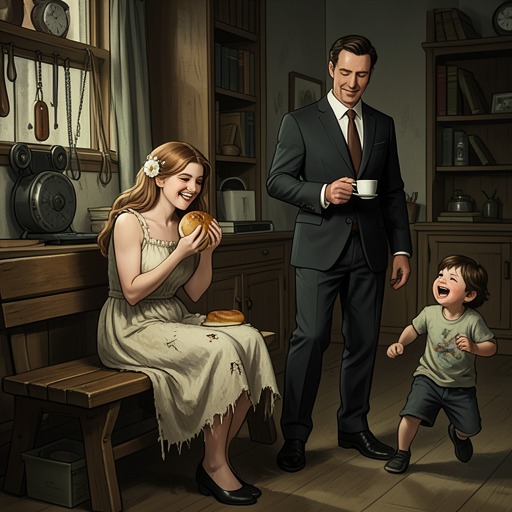
Shen Tang approaches the meal from a position of restraint. In order to maintain her figure, she eats very little, merely tasting the dishes before setting down her chopsticks. Her own limited consumption makes Gu Huaian’s continued eating especially absorbing: she asks him to try a soup dumpling, praising its thin skin and generous filling, and then continues directing food toward him. The scene therefore places two bodily regimes side by side. Shen Tang practices controlled intake, while Gu Huaian becomes the visible recipient of the appetite she cannot indulge herself.
Tao Sister notices the danger before Shen Tang does. As Gu Huaian eats more and more, Tao Sister worries that he must already be full. Gu Huaian is indeed completely stuffed, but when Shen Tang looks regretful, he nevertheless insists that he is not full. Shen Tang responds with evident happiness, placing a brown sugar cake into his bowl and urging him to try it. His compliance keeps the affectionate performance of the meal going, but it also removes the point at which appetite should have yielded to bodily limits.
The immediate consequence is explicit: eating too much and too haphazardly causes Gu Huaian to develop gastritis and require hospitalization. The episode’s causality is domestic rather than dramatic in origin. No public scandal or external enemy produces the crisis; it grows out of a small exchange of attention, appetite, and reluctance to disappoint. Shen Tang’s desire to watch Gu Huaian eat becomes the behavior that sends him to the hospital.
Hospitalization and Reversed Care
Shen Tang reacts with immediate guilt. She recognizes that, had she not wanted to watch him eat and continued picking dishes for him, Gu Huaian would not have ended up in the hospital. She apologizes and takes responsibility, but Gu Huaian rejects her attempt to carry the entire blame, telling her that he had wanted to eat. His answer preserves the episode’s shared causality: Shen Tang encouraged the excess, yet Gu Huaian also chose to continue.
The illness reverses the established pattern between them. Shen Tang reflects that in the past she had always been the one who became sick; this time, Gu Huaian is the patient. She consequently decides to care for him seriously rather than treating the hospitalization as a brief inconvenience. She pours tea, administers medicine, peels fruit, and calls the doctor, attending to each task with deliberate thoroughness. The care extends even to accompanying him when he needs to use the toilet, turning the ordinary logistics of illness into a sustained demonstration of concern.
For Gu Huaian, being cared for has an emotional reward beyond physical relief. Shen Tang’s attention gives him the feeling that her eyes and heart are focused exclusively on him. At the same time, he considers pretending to remain ill because he enjoys the care, but fears that Shen Tang might instead regard him as too weak. The episode thus presents illness as both vulnerability and a temporary privilege: it makes Gu Huaian dependent, but it also grants him an intensity of attention that his ordinary life rarely permits.
The Limits of Recovery
Gu Huaian’s hospitalization occurs while his company is approaching a critical moment. The person responsible for his death in his previous life is close to revealing their hand, so his illness cannot be separated from the larger threat structure of his story. The hospital is a place of enforced pause, but the surrounding plot is accelerating. Physical recovery therefore competes with the need to confront an enemy whose move may determine whether Gu Huaian can avoid the fate he remembers.
After completing his intravenous treatment, Gu Huaian chooses to leave the hospital rather than remain under observation. The decision shows how quickly his obligations override the comfort of being cared for. Shen Tang worries about him, and because she is free, she follows him to work. Her choice carries the domestic concern of the hospital into the professional world: she does not merely send him away and resume her own affairs, but accompanies him as he returns to the company.
The two go directly to the floor containing Gu Huaian’s office. The transition from hospital to office compresses the episode’s movement from bodily excess to corporate danger. Gu Huaian’s stomach has forced him into dependence, yet the unresolved threat connected to his previous death draws him back into action almost immediately. Shen Tang’s presence beside him provides continuity between care and confrontation, even as the workday restores the external pressures that illness briefly suspended.
Narrative Significance
The episode gives material form to an intimacy that could otherwise remain ambiguous. Shen Tang and Gu Huaian’s relationship begins within a contractual arrangement whose terms keep them physically distant except when necessary, but the hospitalization creates an involuntary closeness organized around touchless practical service, emotional attention, and mutual acknowledgment of responsibility. Shen Tang’s care is not presented as a formal duty; it arises from remorse and attachment, while Gu Huaian’s reassurance prevents the crisis from becoming a simple accusation.
It also complicates the public-performance patterns surrounding Shen Tang. Elsewhere, she maintains a professional smile while black fans insult her during a livestream, and her company exploits scandal by pairing her with male celebrities to generate attention. The meal is different: its audience is intimate, and its consequences cannot be converted into a publicity benefit. The smile and the carefully managed public persona give way to medicine, tea, fruit, and a pale patient who needs assistance.
The reversal from Shen Tang’s recurring illness to Gu Huaian’s gastritis gives their bond a new rhythm. Earlier care has apparently moved in one direction, with Shen Tang as the vulnerable party; now Gu Huaian must accept dependence, while Shen Tang becomes the responsible caregiver. Yet the ending prevents this new arrangement from settling into domestic calm. Once the infusion is finished, Gu Huaian returns to work because the danger in his company is nearing its decisive stage. The episode consequently joins tenderness to urgency: a meal reveals affection, overeating produces illness, care creates closeness, and the larger plot pulls the couple back toward conflict before recovery is complete.